The Lens We Look Through
Where were you born?
Into which culture or religion?
Pause for a moment and consider those questions.
Because the answer shapes far more than we realise.
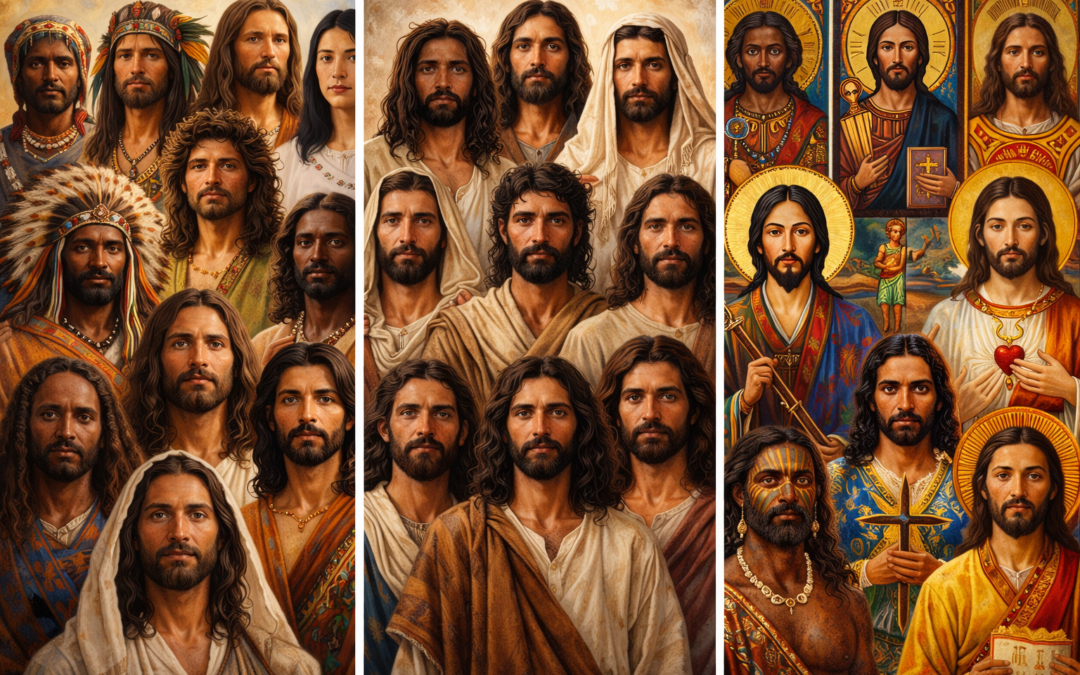
Now ask yourself another question: how do you envision Jesus?
For many people in the West, an image instantly appears — light skin, long brown hair, gentle eyes, soft robes. It is an image repeated in churches, paintings, films, school books and Christmas cards. To many, it feels natural, almost unquestionable.
But if you ask the same question somewhere else in the world, the answer often looks very different.
In Ethiopia, Jesus is depicted with Ethiopian features.
In Korea, Jesus may look Korean.
In Latin America, he may resemble the people there.
In parts of Africa, he may be portrayed as a Black man.
Each culture imagines him through its own lens.
And that lens is rarely questioned because it feels like truth. But what it really is, most of the time, is familiarity.
We tend to see the world through the stories, images and beliefs we were handed as children. They become the framework through which we interpret everything — faith, morality, identity, belonging.
This is not something we consciously choose. It is simply the culture we were born into.
But the moment we believe that our lens is the only correct one, something subtle begins to happen.
We start judging.
Other religions become “wrong”.
Other cultures become “confused”.
Other traditions become “dangerous”.
And before long, the quiet belief underneath it all begins to whisper:
We are right. They are wrong.
That belief has shaped human history more than almost anything else.
Fear and the Human Need to Feel Safe
Fear is one of the most powerful forces in the human mind.
At its core, fear is not evil. It is protective. It evolved to keep us alive. It scans the environment constantly asking a simple question:
Are we safe?
But fear can also narrow our vision.
When people look different, speak a different language, practise a different religion, or arrive from unfamiliar parts of the world, fear can easily step in and fill the gaps where understanding is missing.
We may find ourselves saying things like:
“They should go back where they came from.”
Often this is spoken without imagining what “back” actually means.
Back may mean war.
Back may mean torture.
Back may mean persecution.
Back may mean death.
Most people who say these words are not consciously wishing harm on others. In many cases the deeper feeling underneath is simply this:
I want to feel safe.
Humans fear the unknown. When resources feel scarce, when the world feels unstable, when the future feels uncertain, the mind searches for something to blame or remove in order to restore safety.
And the easiest target is often the visible outsider.
Someone who looks different.
Speaks differently.
Prays differently.
Fear simplifies the world into two groups:
Us and them.
But history repeatedly shows what happens when that line hardens.
Division grows.
Suspicion grows.
Hatred grows.
And people stop seeing each other as human beings.
The Narrow Lens
The tragedy is that the lens most people are looking through was never chosen.
It was inherited.
From parents.
From communities.
From churches.
From history.
The images of Jesus many people grew up with were not historical photographs. They were interpretations shaped by artists living centuries later, inside particular cultures.
Yet those images often became the unconscious template for what “holy”, “good”, or even “civilised” looks like.
When the lens is narrow, anything outside of it can begin to feel threatening.
And when fear enters the picture, compassion often leaves the room.
When Fear Becomes Political
Fear is not only powerful in individuals. It is powerful in societies.
And because of that, it can be powerful in politics.
Throughout history, political campaigns have often been built around promising safety. They present simple solutions to complex problems. They promise protection, control, security.
Sometimes those campaigns sound convincing. They speak directly to the anxieties people already feel.
But beneath the surface, something else can be happening.
Fear can be shaped into narratives that quietly turn one group of people into the problem. Entire communities can become symbols of danger, instability or threat.
When that happens, policies can begin to look like solutions while actually placing vulnerable human beings back into situations they fled in the first place.
War zones.
Persecution.
Violence.
In these moments, fear is no longer simply protecting people.
It is being used.
And the people who suffer most are often those with the least power to defend themselves.
Seeing Through a Wider Lens
Perhaps the more honest question is not:
Which image of Jesus is correct?
But rather:
What does it reveal about us that we each see him in our own image?
Maybe the deeper invitation is to recognise that every culture, every religion, every human community is looking through a lens shaped by its own story.
When we understand that, something softens.
We may still hold our beliefs.
We may still value our traditions.
But we become less certain that our view is the only one worth seeing.
And in that widening of the lens, something important becomes possible again:
Curiosity instead of judgement.
Compassion instead of fear.
Human connection instead of division.
Because long before we are English, Ethiopian, Muslim, Christian, atheist, migrant or citizen—
we are something far simpler.
Human.
How counselling can help
If you are finding yourself anxious about what is happening in the world, struggling to sleep, or feeling fearful about safety for you and your family, counselling can offer a calm and confidential space to explore these feelings. Together we will form a therapeutic relationship, a safe space to gently look at what is fuelling your fears, including the impact of constant news, social media and political messaging, while learning ways to settle and regulate your nervous system so you can think more clearly, feel safer within yourself, and respond to the world from a place of steadiness rather than fear.
Are you ready to talk?
I offer a low-cost confidential service. I offer space to speak, find your voice, be really heard and validated. I am a trained professional counsellor who specialises in anxiety and trauma. Make an appointment to meet me and tell me what you want from counselling. See if you feel comfortable. The first session is over Zoom for both of our safety and then you can do sessions over Zoom from your own home or in person in mine, in my safe, comfortable therapy room.
Book your appointment today
Click here and book a free initial consultation with me today. Read what people are saying about working with me in counselling here. I hold a private, confidential space for you. I’m looking forward to meeting you and hearing you very soon. Best wishes, Karen.
Disclaimer: I am a UK qualified person centred counsellor specialising in anxiety and trauma within the context of counselling. I write from my experiences and from my client work in counselling. My work is dependent on the therapeutic relationship and the meeting of two minds. It is a humbling experience and that is all part of the healing process that I witness every day. It is the best job in the world. This is not an emergency service. If you need to speak to someone urgently outside of my sessions, please call the Samaritans on 116 123 (24/7 confidential helpline in the UK).